When it comes to anti-aging, retinol often steals the spotlight. Hailed as the gold standard for reducing wrinkles and improving texture, it’s a powerhouse ingredient that deserves its reputation. But in the quest for a firmer, more lifted complexion, relying on a single star player isn’t the most effective strategy. A whole team of powerful actives is ready to support your goals, and understanding the best **skincare ingredients for skin tightening** is key to building a truly effective routine.
While we love what a good retinoid can do (as we covered in our Retinol for Beginners guide), this article is dedicated to the other all-stars. At VivantBeauty, we’re diving deep into the science behind the best skincare ingredients for skin tightening that work to boost collagen, protect elastin, and restore your skin’s youthful bounce
Why a Multi-Ingredient Approach is Key
The secret to successfully **treating sagging skin** isn’t finding one magic bullet, but creating a comprehensive strategy. Different ingredients work through different biological pathways to achieve a common goal: a stronger, denser, and more resilient skin structure. By incorporating a variety of these actives into your routine, you’re tackling the problem from multiple angles, leading to better and more noticeable results. This multi-faceted approach is a core principle of our Ultimate Guide to Treating Sagging Skin.
Top Skincare Ingredients for Skin Tightening
Here are the science-backed ingredients, beyond retinol, that you should look for on your product labels if you want to improve skin firmness and elasticity.
1. Peptides: The Cellular Messengers
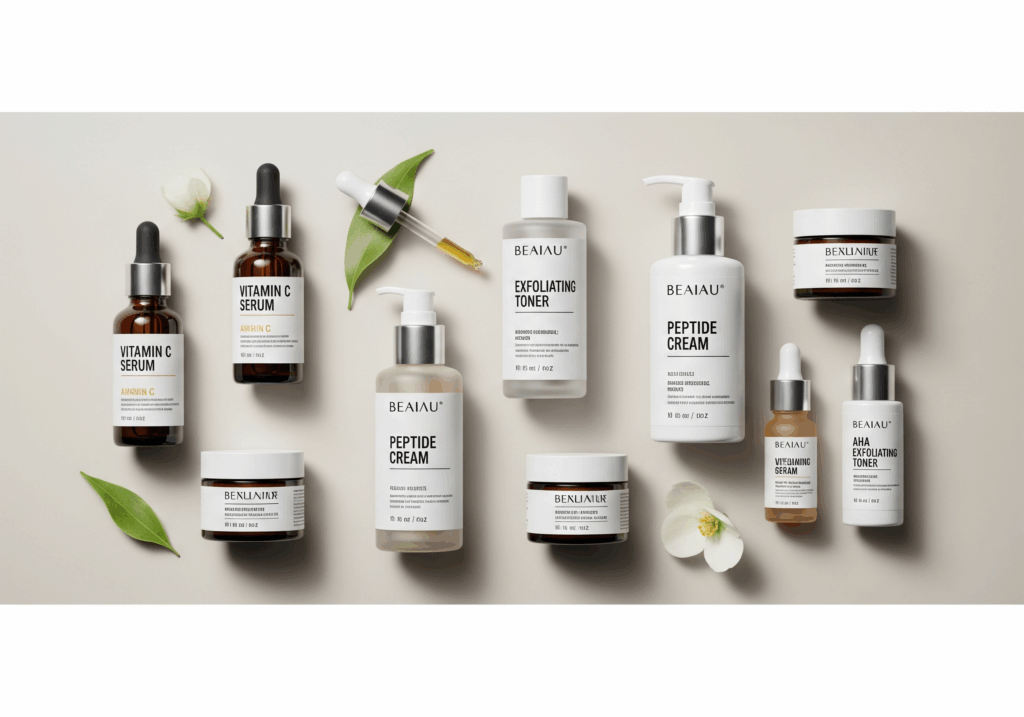
Peptides are short chains of amino acids that act as signaling molecules, sending messages to your skin cells to perform specific jobs. When it comes to skin tightening, their most important job is telling your skin to produce more collagen. Because they are so versatile and gentle, they are one of the absolute best ingredients for firming the skin. We take a deeper look at the different types in our guide to The Top 5 Peptides for Wrinkles.
Best for: Improving overall firmness and reducing the appearance of expression lines.
2. Vitamin C (L-Ascorbic Acid): The Essential Protector & Builder
Vitamin C is a non-negotiable in any anti-aging routine. It plays a crucial dual role. First, as a powerful antioxidant, it protects your existing collagen from damage caused by free radicals from UV exposure and pollution. Second, and just as importantly, your body cannot efficiently produce new collagen without it. As confirmed in numerous studies, Vitamin C is an essential cofactor in collagen synthesis. Using a Vitamin C serum every morning is one of the best ways to protect and build your skin’s firmness.
Best for: Protecting existing collagen, brightening the complexion, and supporting new collagen production.
3. Alpha Hydroxy Acids (AHAs): The Exfoliating Stimulators
Acids like Glycolic Acid and Lactic Acid are famous for their exfoliating properties, whisking away dead skin cells to reveal a smoother, more radiant surface. But their benefits go deeper than that. Studies have shown that consistent use of AHAs can stimulate collagen production in the dermis, helping to improve skin thickness and firmness over time. They essentially provide a gentle workout for your skin’s regenerative processes.
Best for: Improving skin texture while providing a long-term firming benefit.
4. Niacinamide (Vitamin B3): The Barrier Builder
While not a direct collagen-booster, Niacinamide is a fantastic supporting ingredient for skin elasticity. It’s known for its ability to strengthen the skin barrier, improve hydration, and reduce inflammation. A healthy, resilient skin barrier is better able to retain its shape and firmness. Niacinamide also has antioxidant properties and can help improve the appearance of enlarged pores, which often accompany a loss of skin firmness.
Best for: Supporting overall skin health, improving elasticity, and reducing redness.
5. Growth Factors: The Advanced Repairers
Growth Factors are proteins that regulate cellular growth and repair. In skincare, they are used to encourage the skin’s natural healing and regeneration processes, which can lead to increased collagen and elastin production. While they are often found in more premium-priced products, they represent the cutting edge of topical treatments for skin rejuvenation and are beloved by dermatologists for their efficacy.
Best for: Advanced repair, improving skin density, and accelerating results.
Don’t Forget Complementary Treatments
Topical ingredients are the foundation, but their effects can be enhanced by at-home or in-office treatments. Technologies that stimulate the skin on a deeper level can amplify your results. For example, using an at-home device that provides red light therapy benefits can be an excellent way to further boost cellular energy and collagen synthesis, making your topical products work even more effectively.
Frequently Asked Questions (FAQs)
Q1: Can I use all of these ingredients at once?
A: You should not introduce them all at once. Introduce new active ingredients one at a time, especially potent ones like AHAs, to ensure your skin tolerates them well. A good routine might include Vitamin C in the morning, and alternating nights between a peptide serum and an AHA serum.
Q2: Which ingredient is the absolute best for skin tightening?
A: There is no single “best” ingredient. The ideal approach combines a protective antioxidant like Vitamin C, a collagen-signaling agent like Peptides, and a powerful cell-communicating ingredient like Retinol (used on alternate nights). This multi-pathway approach will yield the best results.
Q3: How long until I see results in skin firmness?
A: Consistency is everything. With any ingredient that works by stimulating new collagen, you should expect to wait at least 3-6 months before seeing significant, lasting improvements in skin firmness and tightness.