When topical skincare products are no longer delivering the firming results you desire, it might be time to explore professional treatments. In the world of non-invasive cosmetic procedures, two powerhouse treatments consistently stand out for their ability to combat sagging skin: microneedling and radiofrequency. Both are celebrated for their ability to stimulate collagen production, but they work in fundamentally different ways. This often leads to the big question: when it comes to **microneedling vs radiofrequency**, which is the best treatment for sagging skin?
At VivantBeauty, we believe in empowering you with clear, science-backed information to make the best choices for your skin. This guide will break down how each treatment works, their unique benefits, and who is the ideal candidate for each, helping you understand the best path forward in your journey to a firmer, more youthful complexion.
How Microneedling Works: The “Controlled Injury” Approach
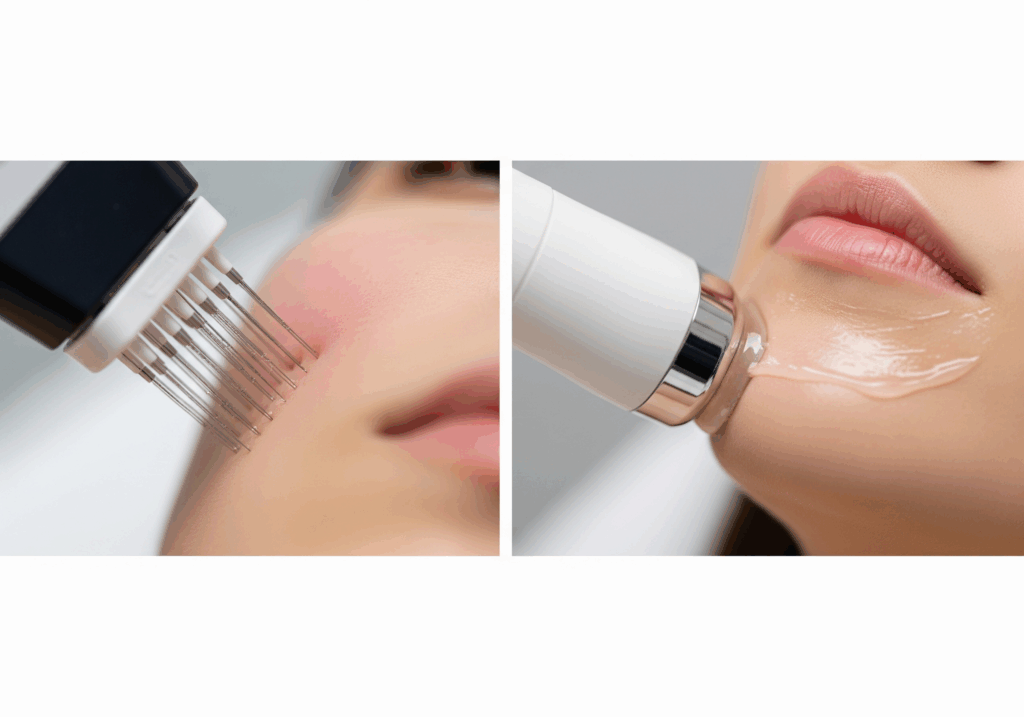
Microneedling, also known as collagen induction therapy, works on a simple yet brilliant principle: it triggers your skin’s natural healing process. The procedure uses a device equipped with dozens of tiny, sterile needles to create thousands of microscopic punctures in the skin’s surface.
These micro-injuries are too small to cause actual scarring, but they are enough to signal your body to go into repair mode. This process stimulates the production of new, healthy collagen and elastin. Over a series of treatments, this new collagen helps to thicken and “plump up” the skin, improving its firmness and reducing the appearance of fine lines and scars. For this reason, **microneedling for sagging skin** is often most effective for mild to moderate laxity.
Pros of Microneedling:
- Excellent for improving skin texture, fine lines, and acne scars in addition to firmness.
- Can be used on almost all skin types and tones.
- The treatment depth can be adjusted to target specific concerns.
Cons of Microneedling:
- Can involve some downtime (typically 1-3 days of redness, similar to a sunburn).
- Results are gradual and require a series of treatments (usually 3-6 sessions).
- May not be as effective for more significant skin sagging.
How Radiofrequency (RF) Works: The “Gentle Heat” Approach
Radiofrequency treatments work in a completely different way. Instead of creating a physical injury, **radiofrequency for skin tightening** uses energy waves to gently heat the deeper layers of your skin (the dermis) while keeping the surface cool and comfortable.
This controlled heating has a dual effect. First, it causes the existing collagen fibers in your skin to contract, resulting in an immediate, subtle tightening effect. Second, and more importantly, this thermal effect stimulates your fibroblast cells to produce new collagen and elastin over time. As multiple clinical studies have shown, RF is a proven and effective technology for dermal remodeling and skin tightening.
Pros of Radiofrequency:
- Typically involves zero downtime; you can return to your daily activities immediately.
- Excellent for targeting skin laxity and providing a noticeable lifting and tightening effect.
- Can be used on the face, neck, and other areas of the body.
Cons of Radiofrequency:
- Results can be subtle at first and build over several months.
- A series of treatments is required for optimal, long-lasting results.
- Less effective for addressing surface-level texture issues like acne scars.
Microneedling with Radiofrequency: The Best of Both Worlds
Increasingly, dermatology clinics are offering combination treatments that unite these two powerful technologies. RF Microneedling devices (like Morpheus8 or Vivace) use needles that not only create micro-channels but also deliver radiofrequency energy directly into the dermis. This allows for a much more powerful, synergistic collagen-stimulating effect, targeting both skin texture and deep-level firmness simultaneously.
The Verdict: Which Treatment is Right for You?
So, what is the **best treatment for sagging skin**? The answer depends on your primary concerns and goals.
- Choose Microneedling if… your main concerns are fine lines, poor skin texture, or acne scars, with mild skin sagging.
- Choose Radiofrequency if… your primary concern is skin laxity and a loss of firmness, and you want a treatment with no downtime.
- Consider RF Microneedling if… you want the most dramatic results and are looking to address both texture and significant sagging at the same time.
No matter which path you choose, these professional treatments can significantly enhance the results of your daily skincare routine. They are a powerful step up in any comprehensive plan, as we outline in our Ultimate Guide to Treating Sagging Skin.
Frequently Asked Questions (FAQs)
Q1: Do these treatments hurt?
A: A topical numbing cream is applied before microneedling to ensure comfort. Most patients describe the sensation as a light scratching or vibration. Standalone radiofrequency treatments are generally painless and feel like a warm massage.
Q2: How many treatments will I need?
A: For both microneedling and radiofrequency, a series of at least 3-6 treatments, spaced about 4-6 weeks apart, is typically recommended to achieve the best and most lasting results.
Q3: How long do the results last?
A: The new collagen your body produces is permanent. However, the natural aging process continues. Most practitioners recommend a maintenance treatment once or twice a year to maintain your results after your initial series is complete.